Electromagnetic (EM) wave polarization describes the geometric orientation and time evolution of the electric field vector E at a fixed point in space. Because the magnetic field B is orthogonal to E and to the direction of propagation (from Maxwell’s equations), polarization is fully characterized by the behavior of E in the transverse plane.
For a monochromatic plane wave propagating in the +z direction:
Polarization depends on the relative amplitudes and phase difference between \(E_x\) and \(E_y\).
A general case of tilted elliptical polarization is illustrated in the following figure.
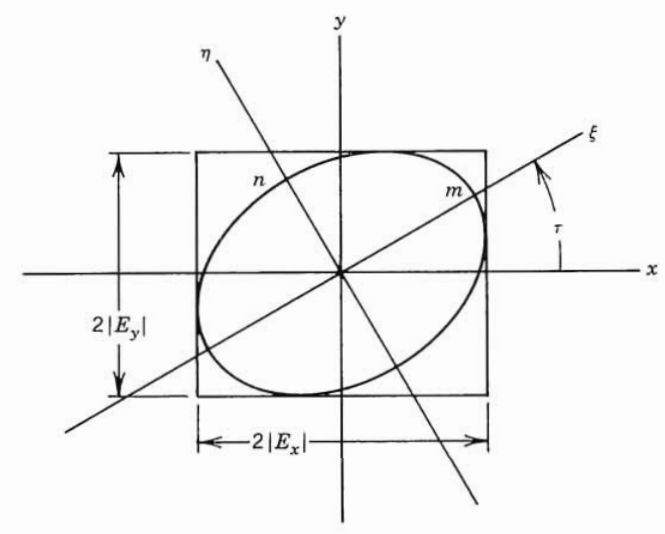
Polarization in Cartesian Coordinate System
The time-invariant \(\mathbf{E}\) field of Equation [\ref{eq:gen_wave_pol}] may also be written as
For convenience, the distance and time phase term has been dropped. Without loss of generality, \(E_0\) and \(\phi\) are chosen so that \(a\) and \(b\) are nonnegative real and \(a^2+b^2=1\). The value of \(E_0\) does not affect the wave polarization in any way except in questions concerned with power. So \(E_0\) will be neglected.
The polarization ratio, \(P\), is defined as
The modified polarization ratio, \(p\), is defined as
Axial ratio of elliptical polarization is defined as the ratio of semi-major axis to semi-minor axis. The axial ratio can be calculated in terms of \(p\):
The tilt angle, \(\tau\), can be found as
where the angle \(\alpha\) is defined as
\(\tau\) can also be found as
The \(\mathbf{E}\) filed can also be written in terms of \(AR\) and \(\tau\) as:
where \(s=\pm1\) is for rotation sense. \(s=+1\) for left-handed polarization and \(s=-1\) for right-handed polarization.
It can be written in terms of inverse axial ratio \(\gamma=\frac{1}{AR}\) (\(0\le\gamma\le1\)) as:
Linear Polarization
- when \(a=0\), the polarization is vertical polarization, and \(\phi\) is irrelevant. The axial ratio is infinite and tilt angle is 90 degree.
- When \(b=0\), the polarization is horizontal polarization. The axial ratio is infinite and tilt angle is 0 degree.
- When \(\phi=0\), the polarization is a linear polarization. The axial ratio is infinite and tilt angle is same as \(\alpha\).
- When \(\phi=\pi\), the polarization is a linear polarization. The axial ratio is infinite and tilt angle is same as \({\pi}-\alpha\).
Elliptical Polarization
For scenarios other than linear polarizations, the polarizations will be elliptical polarizations (including circular polarizations). To determine the rotation sense, an auxiliary angle \(\delta\) is defined as
The axial ratio can be calculated as
The rotation sense can be determined as
Therefore, the sign of \(\sin\phi\) defines the rotation sense since \(\sin 2\alpha>0\).
Also, \(Re(p)=-\frac{b}{a}\sin\phi\), thus
When \(\phi=\frac{\pi}{2}\) and \(a\ne b\), the tilt angle will be 0 degree if \(a>b\) or 90 degree if \(a<b\), which means the x and y axes are aligned with semi-major and semi-minor axes of the polarization ellipse. The axial ratio \(AR = max\{\frac{a}{b},\frac{b}{a}\}\). The rotation sense will be left-hand since \(\sin 2\delta>0\).
When \(\phi=-\frac{\pi}{2}\) and \(a\ne b\), the tilt angle and axial ratio are sames as \(\phi=\frac{\pi}{2}\) case. The rotation sense will be right-hand since \(\sin 2\delta<0\).
When \(a=b\) and \(\phi \ne \pm \frac{\pi}{2}\), the tile angle will be always 45 degree if \(\cos \phi>0\) and always 135 degree if \(\cos \phi < 0\).
Circular Polarization
Circular polarization is a special case of elliptical polarization. It occurs when \(a=b\) and \(\phi=\pm\frac{\pi}{2}\). It is left-hand when \(\phi=\frac{\pi}{2}\) and right-hand when \(\phi=-\frac{\pi}{2}\). Tilt angle is irrelevant and axial ratio is 1.
Circular Wave Components
Consider the complex vectors:
It is clear that \(\mathbf{\omega_L}\) is a left circular wave (\(a=b\), \(\phi=\frac{\pi}{2}\)), and \(\mathbf{\omega_R}\) is a right circular wave. The field \(\mathbf{E}\) can be expanded in terms of \(\mathbf{\omega_L}\) and \(\mathbf{\omega_R}\), giving
Solving for \(L\) and \(Re^{j\theta}\) gives,
Circular polarization ratio, \(q\), is defined as
The modified polarization ratio can be obtained as
The axial ratio can be given in terms of \(q\) as
The tilt angle is given by
The magnitude of \(q\) defines rotation sense as
\(|q|<1\) corresponds to \(|L|<|R|\), which results in a right-hand rotation.
Comments